Advertise on a moving, interacting 3D billboard that's out 24/7.
Everything you and your designer need to produce a compliant Rollout wrap — pricing, panel system, scannability rules for QR placement, file specs, and the production timeline.
What you're buying
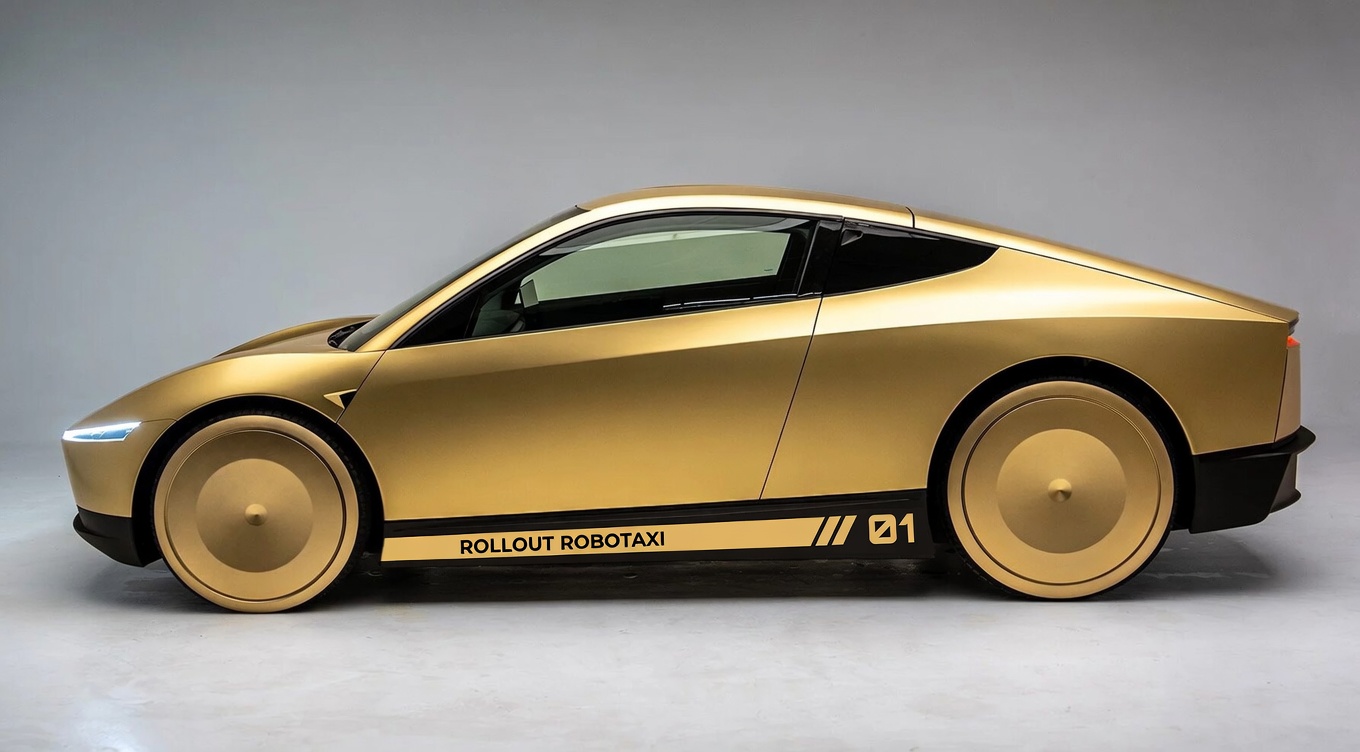
A monthly lease on advertising real estate across one or more Rollout Cybercabs operating on the Tesla operator program. Your wrap is applied to the Cybercab’s hot-swappable body panels — an OEM feature Tesla designed for exactly this use case. When your lease ends, panels come off as a set.
Hot-swap between advertisers requires 2+ panel sets per Cybercab. Tesla has not yet confirmed spare panel-set availability; until confirmed, advertiser-to-advertiser changeovers may require ~2 weeks between tenants (pending Tesla response). Your account reflects the confirmed cadence at signing.
Brand and Conversion tiers include up to 4 scannable QR codes at advertiser-chosen positions, validated against scannability rules (not on glass surfaces, away from Cybercab sensor zones). Scans route to a Rollout-hosted branded offer page at rolloutrobotaxi.com/ads/yourbrand or to your own URL, depending on tier. Full scan and click-through analytics come with either tier.
Pricing & tiers
Three tiers. Pick the shape that fits your campaign. Brand and Conversion carry the same $1,000/mo per-vehicle rate — you pick based on attribution depth, not budget.
- Full creative control across all panels
- Hot-swap installation
- Fleet-dispatch impression estimates (no per-scan data)
- No QR commitment — your canvas, your choice
- Everything in Base Wrap, plus:
- Up to 4 QR panels at advertiser-chosen positions
- Scan count + location + device analytics
- QR routes to any URL you specify
rolloutrobotaxi.com/ads/yourbrand — built from a simple form at signing, no dev work required.- Everything in Brand Wrap, plus:
- Rollout-hosted mobile-optimized offer landing page
- Funnel analytics: scan → page view → click-through to your site
- Shareable offer codes — every shared scan is another impression
- Commitment: you offer a customer-facing 10–25% off, a free service, or an equivalent concession
All three tiers carry a $0.25-per-first-hand-impression overage, invoiced quarterly against confirmed Tesla ride-count data. Overage tracks verified riders — each confirmed passenger is a confirmed first-hand impression of your wrap. Street exposure (drive-by viewers, stationary observers at depots or charging stops) is a separate, fuzzier metric we do not use for billing; the overage we charge against is the rider count Tesla’s platform settles, full stop. Base monthly covers production, install, and onboarding regardless of rider volume.
Initial 3-month cycle is quarterly-prepay (covers production + install + onboarding). After the first cycle, advertiser elects monthly or continued-quarterly billing, with 30-day written notice for cancellation. No annual commitment required.
Static billboards can't carry an offer that's exclusive to a moving vehicle. Conversion Wrap turns your wrap into a trackable promotional channel — you can measure cost-per-redemption, not just cost-per-impression. Most small-to-mid-size advertisers will see better ROI here than on an equivalent outdoor or social spend.
Wrap material & panel system
Cybercabs have hot-swappable exterior body panels. A full wrap covers the swappable panel set; production, install, and removal happen on our end.
| Spec | Value |
|---|---|
| Vinyl | 3M IJ180Cv3 or equivalent 7-year-outdoor-durability film (UV-protected, Pantone-match capable, non-permanent removal grade) |
| Install | 4 hours per Cybercab (same-day, room-temperature vinyl application, photo-documented quality check before vehicle returns to service) |
| Removal | 2 hours per Cybercab (vinyl peels cleanly with non-permanent-grade adhesive; panels reused) |
| Production timeline | 7–14 days from artwork approval — confirmed at signing based on current vendor capacity |
| Panel lifespan | Designed for multi-year reuse; your vinyl is swapped, the panels are reused across tenants |
| Single-panel reprint | Supported mid-contract, for creative changes without re-wrapping the whole vehicle |
Specific turnaround guarantees are pending wrap-vendor SLA signature. Current copy represents target turnaround from our selection framework; your account confirms exact dates at signing.
Exact panel dimensions are confirmed at vehicle delivery (Cybercab production began April 2026). This document is updated with measured dimensions as they land; creative timelines are sized accordingly.
QR codes — you choose where
Brand and Conversion tiers include up to 4 QR code panels. Where they go is your call. Rollout validates your chosen positions against scannability rules and installs to your spec.
Scannability rules (what we validate against)
- Not on glass surfaces — QR must sit on a solid panel, not a window
- Clear of Cybercab sensor zones — cameras and ultrasonic sensor locations are confirmed with your wrap vendor at signing
- Solid or high-contrast background strongly recommended — QR error correction tolerates patterned backgrounds, but every reduction in contrast reduces scan reliability (especially in low light)
- Away from the butterfly-door swing path for side placements — so the QR stays visible when the door swings up for boarding
| Spec | Value |
|---|---|
| Minimum size | Confirmed at artwork review based on current empirical scanning testing; industry standard is 6–8 inches at moving-vehicle distance |
| Quiet zone | 0.5 inch light-toned border around each QR module |
| Foreground | High-contrast dark ink on the chosen background |
| File provided by | Rollout — printable QR PNG(s) with your campaign slug are generated in your portal and delivered to your designer |
The Rollout wordmark lives on the vehicle's running board (not on your wrap panels). Applied by Rollout at fleet prep — advertiser does nothing, and it doesn't cost you a single square inch of wrap canvas.
Creative guidelines
What works
- High-contrast designs — the car is moving; subtlety loses
- One dominant message, not three competing ones
- Your phone number, URL, or offer at large scale
- Colors that stand out against typical Evansville backdrops (tarmac, trees, grey sky)
What to avoid
- Placing critical copy where your chosen QR positions will sit (your placements are confirmed at signing)
- Busy or dark patterns directly behind QR zones — QR error correction is forgiving, but solid light backgrounds scan fastest and most reliably
- Thin fonts at small sizes (unreadable at driving distance)
- Copying competitor advertisers — each wrap should be distinctive
Handing off to your designer
You provide print-ready artwork to the Rollout wrap spec (below). Your designer handles file specs, color profiles, bleeds, and layer structure.
We accept industry-standard vector artwork from any competent designer, we'll review it for spec compliance, and one round of revisions is included in your monthly price.
Rollout does not offer wrap-design services. If you don't have a designer, we can refer you to Evansville-area wrap designers who already know our spec.
Discount redemption modes
Three ways the offer / CTA reaches a rider who scans your QR. Modes A and B are advertiser product choices; Mode C is explicitly not offered, and here's why.
Mode A — Static slug page (default, included in Brand + Conversion)
Your offer page lives at rolloutrobotaxi.com/ads/yourbrand. Seven fields in your portal — logo, headline, sub-headline, discount code, redemption instructions, Redeem-Now URL, brand color. Rollout renders a branded offer page from those fields; the scanner taps through to your site for redemption.
Mode B — Tokenized-code pool (premium add-on, +$150/month)
You upload a CSV of single-use codes generated in your own POS or booking system (Toast, Square, Stripe, Mindbody, etc. — native feature of most platforms). Rollout's slug page dispenses one unique tokenized code per scan and marks it dispensed. Your POS validates redemption on your end. Remote activation / deactivation from the advertiser portal; pool-depletion alerts at under 100 codes remaining.
Mode C — Direct-to-your-site (not offered)
We do not encode your own URL directly in the QR. Doing so strips the attribution layer — and attribution is the product you're paying for. The slug page intercept takes a fraction of a second and gives you scan + click-through data you cannot get from a plain URL QR.
The seven fields you fill out in the portal (~10 minutes, one time)
| Field | Example |
|---|---|
| Logo (PNG) | Your brand logo, 500px min width |
| Headline | “$25 off your first appointment” |
| Sub-headline | One line of context (~80 chars) |
| Discount code | BRAND25 |
| Redemption instructions | “Show this code at checkout” |
| “Redeem now” URL | https://yourbrand.com/redeem |
| Brand color (hex) | #2E7D32 |
The slug page uses a 24-hour countdown from first view + tap-to-reveal for the code. That's enough friction to discourage casual sharing and stockpiling. We intentionally stop short of heavy enforcement because screenshot shares (e.g., “scanned a wrapped Cybercab and got 20% off”) are free marketing for both you and Rollout. Perfect enforcement costs more than it saves.
Advertisers don't pay for custom web development, we don't operate N websites, and the template improves for everyone every time we tune it. The theme (logo, color, copy, offer) rotates per advertiser; the structure is proven across the fleet.
Production timeline
- Inquiry & contract — scope call to confirm tier, vehicle assignment, creative spec, content policy; advertiser signs wrap agreement, quarterly-prepay invoice issues.
- Creative kickoff — you or your designer receives this spec + the Rollout-branded required-elements package.
- Creative review — Rollout reviews your wrap artwork for spec compliance (color profile, bleed, layer structure, QR zones, content policy). One round of revisions included.
- Landing-page setup (Conversion tier) — you fill out the 7-field form in your portal.
- Print production — approved artwork goes to our wrap production vendor.
- Install — Cybercab pulled from service for ~4 hours, panels applied and QR placements validated at your chosen positions.
- Live — your wrap is on the road. Monthly billing begins. Analytics visible in your portal.
Typical turnaround from artwork approval to wrap-on-road is 7–14 days. Your account confirms the exact timeline at signing based on current vendor capacity.
Flexibility — scale at your pace
Initial 3-month cycle, then your choice
Quarterly-prepay for the first 3 months (covers production + install + onboarding). After that, elect monthly or continued-quarterly billing at your discretion; 30-day written cancellation notice. Because panels are hot-swappable, an exit doesn't strand you while we figure out logistics.
Scale up (or down) by the vehicle
Start with one car. Add a second, a third, a fifth. All vehicles on one campaign share the same QR destination(s), so analytics aggregate cleanly and you don't pay for duplicate landing pages. Per-vehicle pricing is flat — no volume-discount shenanigans, no surprise tier jumps.
Creative refresh — keep your wrap alive
Static wraps go stale. Advertisers who refresh their creative quarterly outperform those who don't. We built the refresh process to be a feature, not a penalty.
A wrap that sits unchanged for 12 months loses scan rate as it becomes visual wallpaper to locals. A wrap that refreshes quarterly stays novel, gets re-noticed, and delivers measurably higher engagement. If you're committing to wrap advertising, plan to refresh.
Get started
Submit an inquiry — no call, no calendar tag, no sales pressure. You tell us what you're thinking; we reply by email with pricing for your specific campaign and a link to sign up through the portal. The whole sign-up flow is online. Most advertisers go from inquiry to wrap-on-road without ever getting on a phone.